At 09:28, Keith was sitting at his hot-desk on the fourteenth floor of a glass monolith in Canary Wharf, staring into a Pret a Manger filter coffee and trying to stop his left eyelid from twitching.
Before leaving Clapham, he had taken four ibuprofen, two Rennies, and a cold shower, none of which had made the slightest dent in the foundational certainty that his life was over. He had wanted to pull the mains plug out of the back of his Linux workstation, smash the NVMe drives with a claw hammer, and scatter them off Vauxhall Bridge.
Except drunken Keith had anticipated that too.
Right before he had locked the screen to catch the Northern Line, Keith had discovered a root-level cron job running on his home server. Every fifteen minutes, a daemon named coward_check.sh pinged a dead-man’s switch hosted on an encrypted VPS in Reykjavik. If his home relay node went offline for more than six consecutive hours without a signed cryptographic heartbeat from his hardware YubiKey, the Iceland server was programmed to automatically publish a secondary GitHub gist containing the full development commit logs, his home IP metadata, and an automated self-report email to the National Crime Agency’s cyber-crime portal.
Drunken Keith had literally taken sober Keith hostage.
"Morning, Keef," said a cheerful voice.
Keith flinched so hard he spilled half a centimetre of scalding black coffee over the knuckle of his thumb.
Toby, a twenty-six-year-old junior front-end developer wearing an oversized fleece gilet and white trainers that had never encountered an actual puddle, dropped into the Herman Miller chair beside him.
"Rough one?" Toby asked, popping open a can of sugar-free Monster. "You look like you’ve been decompiled, mate."
"Allergies," Keith croaked, blotting his thumb with a brown paper napkin. "Pollen count's dreadful in Zone 2."
"Yeah, savage. Anyway—have you seen it?"
Keith’s heart stopped. His fingers curled into the damp napkin. "Seen what?"
Toby spun his MacBook Pro forty-five degrees across the white laminate desk.
On the screen, taking up the entirety of Toby’s main browser window alongside the VeriComply Jira board, was the brutalist black-and-white interface of DEAD FUND ME.
The red status pill was still pulsing gently: TARGET STATUS: METABOLICALLY ACTIVE.
The escrow counter beneath the Russian President’s portrait now read €4,118,540.82.
"It’s mental," Toby breathed, his eyes shining with the pure, uncritical reverence of a junior engineer witnessing a Senior Principal’s magnum opus. "Someone dropped it on Arbitrum at four this morning. Four point one million euros already, Keef! The whole of crypto-Twitter is losing its mind. Even Vitalik subtweeted the contract architecture—Wait, look at the gas optimisation on the multi-oracle callback."
Toby switched tabs to Arbiscan, pulling up the verified Solidity source code that Keith had written six hours ago while wearing threadbare Marks & Spencer boxers and eating dry-roasted peanuts off his chest.
"Look at line 114!" Toby laughed, pointing a manicured finger at the screen. "The guy left a roast in the production comments for his own sober self. 'I know you, you spineless middle-management jellyfish.' Absolute legend. Apparently they’re calling the developer Archon on Telegram because of the vanity deployment hash."
"Fascinating," Keith managed. His voice sounded as though it were being broadcast from the bottom of an empty well. "Very... irresponsible use of decentralised finance. Surely the authorities will shut the front-end down shortly."
"Can’t," said Priya, the team’s DevOps lead, wheeling her chair over from the opposite pod with a mug of matcha. "It’s pinned across four hundred IPFS nodes and mirrored on ENS and Tor. And the smart contract itself is completely immutable. Me and Marcus in InfoSec spent the last forty minutes reviewing the bytecode instead of doing the Sprint 14 tickets. Whoever wrote this is an actual monster. Like, frighteningly good. Zero admin backdoors, cleanest zero-knowledge claim verification I’ve ever seen, and look—"
She leaned over Toby’s shoulder and tapped the touchpad, scrolling to the bottom of the web interface’s CSS stylesheet in Chrome DevTools.
"They think he’s British," Priya said smugly.
Keith felt the temperature in his extremities drop by approximately twelve degrees. "Do they?"
"Look at the CSS variables," Priya said, zooming in on the inspector pane.
:root {
  --bg-primary: #0d0d0d;
  --text-colour-muted: #4a4a4a; /* proper grey not yank gray */
  --border-radius: 0px; /* //keith rounded corners are for cowards */
}
"Wait," Toby blinked, squinting at the screen before turning his head slowly toward Keith. "Hold on. //keith rounded corners are for cowards. Keef, didn’t you reject my pull request on the Barclays KYC dashboard last month with a //keith todo tag and that exact comment?"
The open-plan office suddenly felt very quiet. Thirty feet away, a laser printer whirred.
Keith looked at Toby. He looked at Priya. In his crisp white poplin shirt, black waistcoat-cardigan, and flat-front black trousers—an ensemble that regularly caused strangers at formal networking events to hand him their empty champagne flutes—and beneath his rigid, geometric Action Man haircut hat of dark hair, every survival instinct honed by two decades of corporate blame-avoidance fired simultaneously.
Unfortunately, so did his nasal septum.
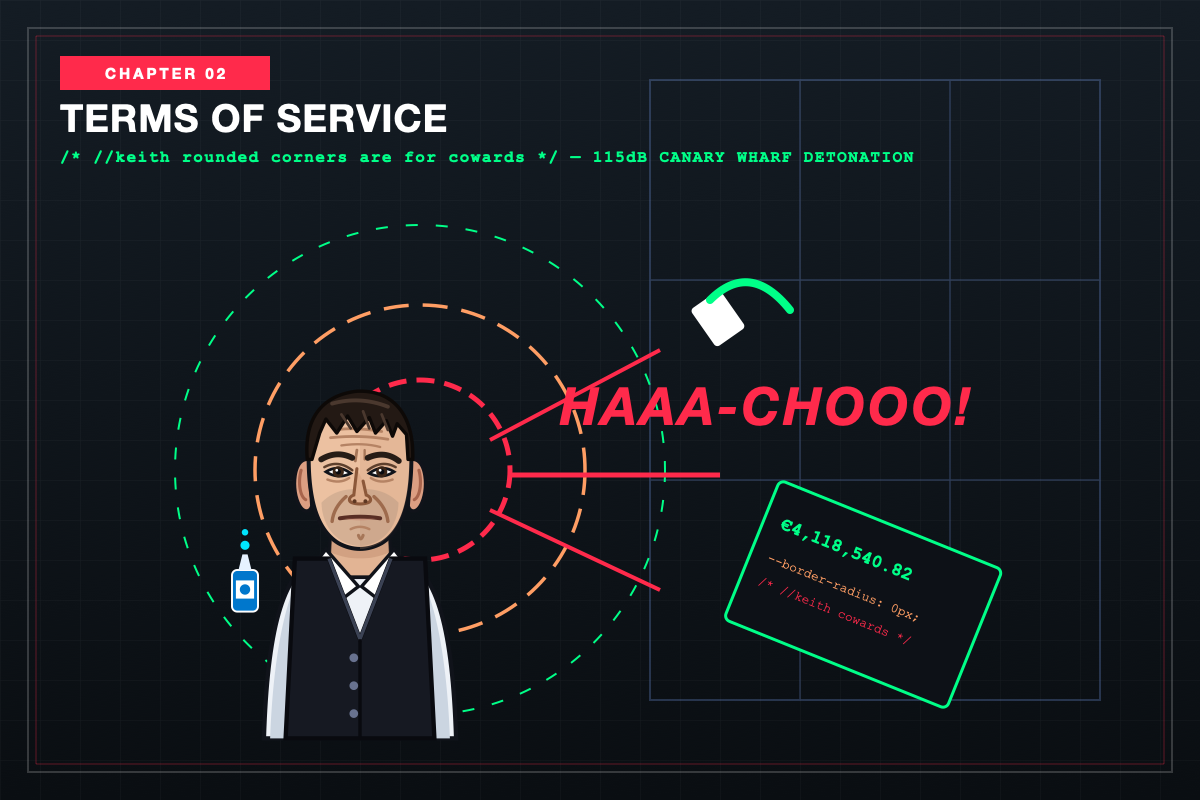
"HAAA-CHOOOOO!"
The detonation echoed off the glass partition wall with the acoustic force of a flashbang grenade. Toby actually yelped, jerking backward so violently his Herman Miller chair hit the pillar behind him, while Priya spilled green matcha across her wrist. Across the floor, three compliance analysts stood up from their cubicles like meerkats scanning for a predator.
"Jesus Christ, Keef!" Toby wheezed, clutching his chest. "Warn a guy! Nearly gave me a cardiac arrest!"
"Sorry," Keith said, pulling his bottle of Optrex from his black waiter trousers and tilting his plastic-helmet head back to administer two rapid drops into his watering eyes. "Dust in the air-con. And as for //keith—it’s not a name. It’s an old Linux kernel shorthand from a 1994 Usenet post by Donald Knuth. K-E-I-T-H. Kernel Execution Inline Todo Hook. Half the graybeards on Hacker News use it."
"Oh," Toby said, his heart rate still recovering from the sneeze. "Right. Fair enough. Still, mental though. Marcus put twenty quid of USDC into the pot from his MetaMask wallet just to say he was part of history."
"Marcus in InfoSec," Keith repeated hollowly, "contributed twenty pounds to an international political assassination fund from the corporate Wi-Fi?"
"Well, via VPN," Priya shrugged. "Everyone’s doing it. Half of Reddit’s treating it like the Eurovision Song Contest. Anyway, stand-up’s starting—Giles is dialing in from Zurich and he’s on a warpath about the AML ingestion latency."
Keith survived the nine-thirty Scrum purely through muscle memory, reciting meaningless phrases about "idempotent Kafka consumer groups" and "horizontal sharding roadblocks" while his peripheral vision tracked the live ticker reflected in Toby’s glasses.
By 10:15, the pot hit €4.6 million.
By 10:45, Sky News broke a segment at the bottom of the silent television screens mounted above the trading-floor kitchenette: UK NATIONAL CYBER SECURITY CENTRE INVESTIGATING 'CROWDFUNDED KREMLIN BOUNTY' WEBSITE.
At 10:52, Keith excused himself to go to the disabled toilet on the thirteenth floor—the only room in the building with a heavy deadbolt and concrete walls thick enough to feel faintly blast-resistant—locked the door, put the lid down on the loo, and pulled out his phone.
He logged into his home workstation via an encrypted WireGuard tunnel.
If Priya had spotted his CSS comment habits within forty minutes of logging on, how long would it take GCHQ or the FSB?
"Think," Keith hissed at himself in the fluorescent bathroom mirror. He looked appalling: pale, pouchy-eyed, with a faint purple Malbec stain still visible along the inner crease of his lower lip. "You're a systems architect. Audit the deployment trail."
He opened a root shell on his Clapham machine and pulled up /var/log/syslog and the bash history from the night before.
Between 23:15 and 01:30, he had been relatively sloppy—browsing news articles about Russian election interference on his normal domestic Virgin Media broadband connection. At 01:42, roughly coinciding with the switch from red wine to the Laphroaig, drunken Keith had spun up the Tails VM and routed all traffic through a three-hop Tor circuit and an anonymous Mullvad wireguard exit node paid for in Monero.
That part was solid. Clean operational security.
Then Keith checked the git configuration inside the deleted temporary build folder he recovered from the swap partition.
He hadn't pushed the repo to GitHub, thank Christ. He had compiled the bytecode locally using Hardhat and broadcast the raw signed hex transaction directly through a public RPC endpoint in Frankfurt.
Wait.
The RPC endpoint.
Keith pulled up the Hardhat configuration file from the cached build buffer.
networks: {
  arbitrumOne: {
    url: "https://arb-mainnet.g.alchemy.com/v2/a8F92kLp0_vComply_Dev_Test_Key99",
    accounts: [process.env.EPHEMERAL_DEPLOYER_PK]
  }
}
Keith stared at the sixty-four-character Alchemy API URL on his phone screen.
He hadn't used a public anonymous RPC node to broadcast the contract deployment. Because public nodes were rate-limited and slow at three in the morning, drunken Keith had copy-pasted the high-throughput enterprise Alchemy API key from his local environment variables.
The development API key registered to his personal corporate sandbox account at VeriComply Ltd.
An account registered to k.clodden@vericomply.co.uk.
Keith’s knees gave way, and he sat down heavily on the closed toilet lid.
Anyone examining the public blockchain could only see the anonymous wallet address 0x71C...9A2. Nobody on Reddit or Twitter could see how that transaction had reached the network.
Except Alchemy’s server logs in San Francisco had recorded the exact API key and originating IP check that submitted the contract creation bytecode at 03:48 BST. The moment a US federal subpoena, a UK National Crime Agency warrant, or a Russian GRU cyber-intrusion hit the infrastructure provider’s ingestion logs, a single SQL query would output his full name, his work email address, and the billing address of the fourteenth floor of One Canada Square.
He had forty-eight hours. Maybe twenty-four. Maybe less, if the Americans didn't bother with a warrant and just asked nicely via an NSA liaison desk.
His phone buzzed in his sweaty palm.
It wasn't a text message. It was an alert from the sandboxed WireGuard notification daemon on his home server.
A new message had just bypassed the 0.5 ETH stake filter on the OnionMail relay—not by paying the fee, but by exploiting a secondary notification function on the smart contract itself: submitOracleDisputeNotice().
Someone had paid four hundred euros in gas fees just to pass an encrypted string directly into his terminal logs.
Keith tapped the console window with a shaking thumb and decrypted the payload with his PGP key.
FROM: kestrel_consultancy_zh@anonbox.onion
SUBJECT: URGENT: Infrastructure Leak / Amateur Compromise
-------------------------------------------------------------------------
Dear Escrow Administrator,

It has come to my attention via a routine telemetry sweep of our commercial
RPC partner nodes in Frankfurt that the contract creation transaction
(0x99f2...c401) was broadcast using a non-anonymous enterprise API key
belonging to a UK financial compliance vendor.

Frankly, given the quality of your Solidity engineering, this level of
deployment hygiene is embarrassing.

I have taken the liberty of executing a radial log-rotation overwrite on the
Frankfurt edge-cache via an existing backdoor our firm maintains for customs
manifest auditing. The Alchemy edge log has been scrubbed prior to daily
S3 archival.

However, the automated billing webhook fired at 04:00 UTC to your corporate
tenant dashboard in London. If your internal Security Operations Centre (SOC)
runs an anomaly sweep on out-of-hours L2 RPC call spikes, your domestic footprint
will be flagged internally within three hours.

I suggest you delete the tenant usage logs before lunch. I have €380,000 in
operational staging expenses committed to the September window and I have no
intention of losing my escrow counterparty to the Metropolitan Police before
Q3.

Do not disappoint me again.

Kind regards,
S.V.
Senior Partner, Kestrel Risk Mitigation
Keith read the message twice.
A freelance Russian assassin living in Zurich had just committed cross-border computer fraud on a German cloud server to cover up his drunken DevOps mistake—purely to protect her own upcoming invoice.
And she was right.
VeriComply’s automated AWS CloudWatch billing alerts ran at 12:00 PM sharp every Tuesday. And the person who reviewed the weekly developer sandbox API usage logs was Marcus in InfoSec.
Marcus, who was currently sitting forty feet upstairs with the Dead Fund Me ticker open on his second monitor.
Keith looked at his watch.
11:04.
Fifty-six minutes until the noon audit script ran. And Keith didn't have admin write-access to the production CloudWatch log groups—only Marcus and the Head of Infrastructure held the root IAM hardware tokens.

